Human reaction time hits an immutable biological ceiling in elite sports. When an athlete waits for an opponent’s physical movement or a puck trajectory to confirm before initiating a motor response, they concede the advantage. Traditional athletic vision programs counter this by drilling reaction speed against static targets in sanitized settings. This protocol addresses the wrong performance constraint.

Elite performers dominate not through faster raw reactions, but through earlier predictive models. They map spatial geometry, pick up subtle kinematic cues in the peripheral field, and calculate trajectories before the play materializes.
For performance directors and tactical staff, stopping at reaction time leaves a massive operational deficit on the table. To compress decision latency and control game tempo, teams must systematically train visual scanning frequency and peripheral target recognition under physical load.
Neural Architecture: Saccadic Mapping and the Dorsal Stream
Visual processing is an active extraction process rather than a static recording. The visual-motor loop governs how fast an athlete converts raw light into coordinated biomechanical output.
Retinal input travels through the optic nerve into the primary visual cortex (V1), where the central nervous system splits visual data into two functional streams:
- The Ventral Stream (“What”): Driven by parvocellular pathways, the ventral stream resolves high-acuity details, shapes, and colors via foveal fixation. It operates with high resolution but incurs significant processing latency.
- The Dorsal Stream (“Where / How”): Driven by magnocellular pathways, the dorsal stream tracks velocity, spatial position, and volumetric depth across the peripheral visual field. It operates at high transmission speeds, routinely initiating preparatory motor signals before the athlete achieves conscious awareness (Appelbaum & Erickson, 2018).
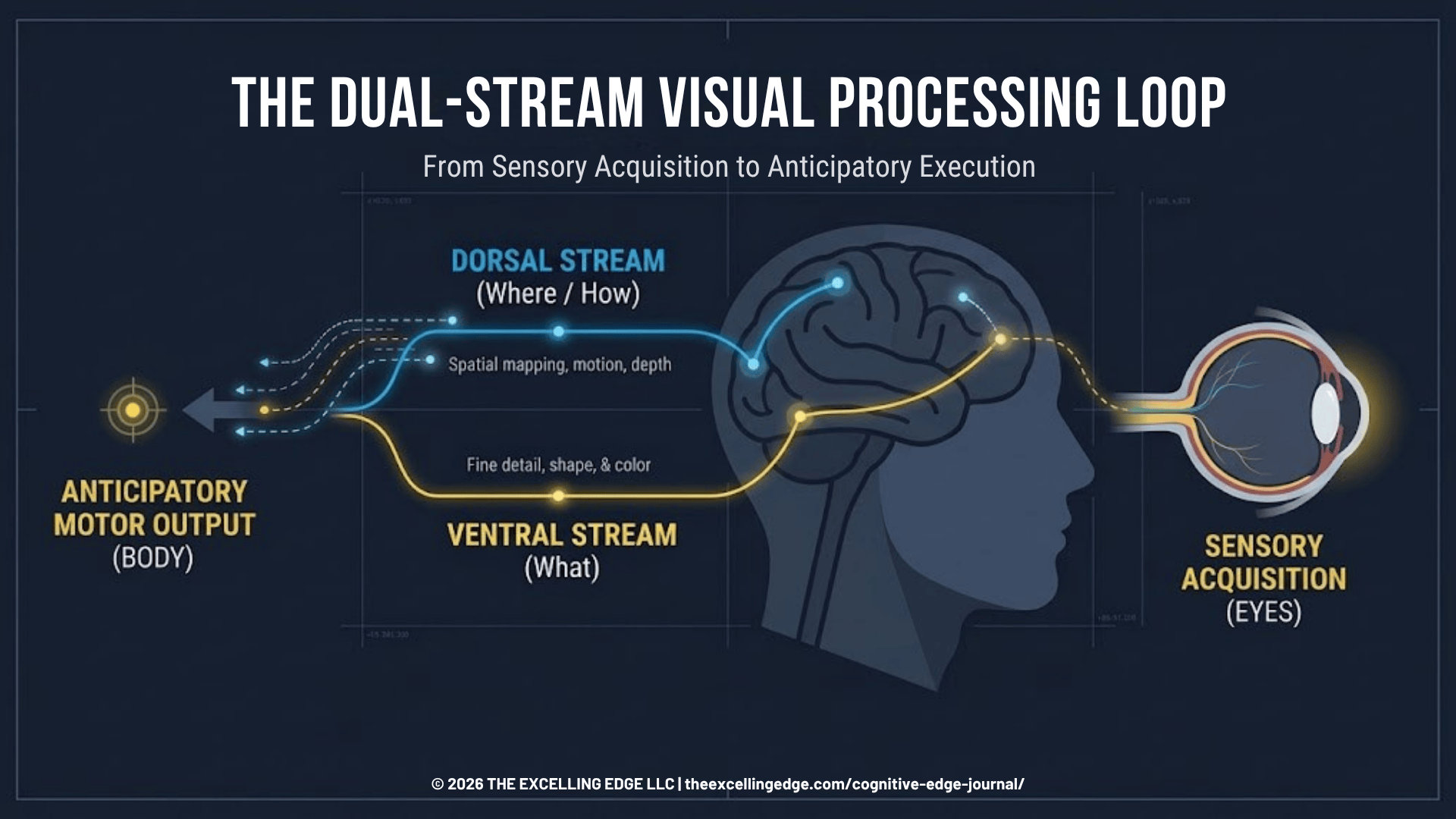
Elite spatial awareness relies on constant dorsal stream activation. An athlete holding broad peripheral awareness feeds the dorsal stream real-time telemetry on closing defenders and open running lanes.
This spatial model is populated by rapid, ballistic ocular shifts known as saccades. Orchestrated by the Frontal Eye Fields (FEF) and the Superior Colliculus, saccades reposition the visual axis to sample points of interest across the pitch or ice. When an athlete checks their shoulder prior to receiving a pass, the FEF directs a structured visual sample. The brain uses these micro-samples to construct an updated predictive spatial model. Inefficient or late ocular mechanics starve the predictive engine of data, forcing the athlete to rely on slow, reactive processing (Aksum et al., 2020).
Lab Note: Mitigating Decision Latency
Decision latency measures the biological delay between environmental stimulus identification and efferent motor output. Training early scanning mechanics expands the functional field of view and engages dorsal-stream predictive processing. This workflow bypasses cortical processing bottlenecks, allowing the brain to formulate motor commands hundreds of milliseconds before physical engagement.
Operational Translation: Validating Scan Rate Dynamics in Elite Football
Diagnostic baselines collected inside our Neuro Performance Center in Surprise, AZ, consistently expose a specific failure pattern among elite competitors: high foveal visual acuity coupled with narrow peripheral utility and poor pre-action visual search strategies. In high-speed scenarios, athletes tunnel their vision, tracking the ball instead of mapping space.
Living Lab Case Study: Campeonato Brasileiro Série A
This performance breakdown directly impacted a premier Brazilian football club dealing with elevated second-half turnover rates, compromised spacing under counter-presses, and sluggish transition speed.
A neuro-visual diagnostic audit revealed intact central visual acuity alongside a pronounced deficit in pre-reception head scanning and peripheral target detection under cardiovascular load. The roster consistently reacted to the ball post-arrival rather than acquiring surrounding field geometry beforehand.
We structured a season-long integration protocol across their weekly training microcycles:
- Perceptual Warm-Up Anchors: We embedded visual scanning constraints into positional passing grids and standard rondos. Players were required to identify dynamic peripheral cues (tactical indicators flashed by coaches outside the active grid) prior to receiving the ball.
- Stroboscopic Interventions: During technical passing circuits, players trained with stroboscopic eyewear operating between 2 Hz and 6 Hz. Intermittent visual disruption forces the dorsal stream to extrapolate trajectory and spatial coordinates from incomplete visual feeds.
- Peripheral Neuro-Visual Diagnostics: Athletes completed weekly off-field sensory training targeting magnocellular pathway sensitivity and expanding visual recognition thresholds across outer peripheral angles.
The on-field impact was measurable. The team demonstrated marked reductions in turnover rates under pressure, accelerated transition sequences, and higher pass-completion percentages in congested central zones. At the conclusion of the season, the club earned direct promotion to Campeonato Brasileiro Série A. The differentiator was not increased cardiovascular volume; it was the systematic upgrade of the athletes’ visual-motor loops.
Lab Note: Empirical Scan Frequencies
Eye-tracking and video telemetry confirm that a player’s exploratory scan rate—defined as rapid head turns exceeding 45 degrees to observe the field outside the immediate ball trajectory—directly dictates passing precision. Elite central midfielders who complete high-frequency visual scans in the 10 seconds before receiving the ball log a statistically significant reduction in turnovers and an increased forward-pass completion rate (Jordet, 2005).
Field Protocol: Systematizing Spatial Acquisition Under Physical Load
Translating ocular neuroscience into on-field execution requires structured, progressively overloaded training protocols. Performance directors and sports science personnel can implement this three-phase framework across team settings. The methodology also directly informs cognitive resilience and real-time situational processing for executives operating under high cognitive volume.
Phase 1: Isolated Oculomotor and Peripheral Conditioning
Establish sensory baseline control prior to applying metabolic or tactical stress.
- Protocol: Athletes stand before wide-field digital reaction boards or dynamic multi-target trackers. Central gaze remains fixed on a focal point while the athlete detects, processes, and manually responds to numerical or color cues flashed across extreme peripheral coordinates.
- Objective: Expand the functional field of view and condition magnocellular pathways to process high-speed positional shifts without needing direct foveal re-centering.
Phase 2: Loaded Scanning via Controlled Sensory Deprivation
Introduce sensory constraints directly into sport-specific motor patterns.
- Protocol: Implement stroboscopic eyewear during position-specific skill reps (e.g., fielding ground balls, receiving hockey passes off the boards, or handling rapid one-touch wall passes). Start at higher flash frequencies (minimal visual occlusion) and reduce flash rates as technical competence stabilizes.
- Objective: Restricting the rate of visual frames forces the central nervous system to accelerate pre-action scanning, extract kinematic indicators from the passer’s body language, and predict object trajectories using sparse inputs (Klostermann & Moeinirad, 2020).
Phase 3: High-Chaos Dual-Task Tactical Overload
Merge perceptual-cognitive requirements with match-intensity physical demands.
- Protocol: Build small-sided games (e.g., 5v5 plus dynamic neutral players) with peripheral cognitive triggers. Staff members stationed along the pitch boundary flash variable color boards or visual signals. Receiving players must execute an over-the-shoulder scan during the ball’s flight, call out the external cue, and execute a predetermined tactical choice tied to that signal (e.g., Red = direct one-touch reset; White = turn and penetrate).
- Objective: Train athletes to extract contextual field data while managing intense physical contact and cardiovascular strain. This stabilizes the visual-motor loop under match conditions, making anticipation an automated physiological habit.
The High-Performing Executive Translation
For C-Suite leaders, the same biological loop governs situational awareness and strategic decision speed. Stress, fatigue, and cognitive volume induce visual tunneling, degrading the brain’s ability to process secondary signals and peripheral risk indicators. Conditioning the visual-vestibular axis and running dual-task cognitive protocols protects against neural fatigue, reinforces working memory, and sharpens executive functioning under volatile conditions.
Structuring the Advantage
Elite athletic performance is governed by how rapidly and accurately the central nervous system acquires, filters, and operationalizes environmental information. Organizations that limit visual preparation to simple reaction tests introduce a systemic performance bottleneck. By conditioning active scanning mechanics, expanding functional peripheral vision, and automating anticipatory spatial mapping, performance staffs can capture substantial gains in execution speed.
If your organization relies strictly on traditional reaction metrics, your athletes are operating with a localized handicap. Do not wait for physical execution to fail before addressing the neurological foundation that dictates it.
Book a 15-Minute Neuro-Performance Audit Call with our clinical staff at the Neuro Performance Center. We will evaluate your current visual-cognitive training protocols and build a targeted framework to minimize decision latency across your roster.
References
- Aksum, K. M., Magnaguagno, L., Bjørndal, C. T., & Jordet, G. (2020). What do football players look at? An eye-tracking analysis of the visual fixations of players in 11 v 11 elite football match play. Frontiers in Psychology.
- Appelbaum, LG, and G Erickson (2016). Sports vision training: A review of the state-of-the-art in digital training techniques. International Review of Sport and Exercise Psychology.
- Jordet, G. (2005). Perceptual Training in Soccer: An Imagery Intervention Study with Elite Players. Journal of Applied Sport Psychology.
- Klostermann, A., Kredel, R., & Hossner, E. J. (2013). The “quiet eye” and motor performance: task demands matter!. Journal of experimental psychology. Human perception and performance.
Please note: I encourage reader discussion, however, I reserve the right to delete comments that are offensive or off-topic.